What defines modern identity infrastructure
Modern identity infrastructure is shifting from centralized credentialing to decentralized, verifiable systems. In the past, your professional identity was fragmented across LinkedIn, email servers, and corporate directories. Today, it is being consolidated into a single, user-controlled framework built on blockchain technology. This shift is not merely technical; it is a structural change in how trust is established in digital professional environments.
At the core of this infrastructure are two critical components: Decentralized Identifiers (DIDs) and Verifiable Credentials (VCs). A DID is a unique identifier that you own and control, not one issued by a central authority. Think of it as your own digital passport number, stored securely in your wallet. A Verifiable Credential is the proof attached to that identity—such as a degree, a professional license, or a work history record—issued by a trusted entity like a university or employer.
This separation of identity from data is the defining feature of Web3 professional infrastructure. It allows professionals to present verified credentials on a need-to-know basis, reducing the risk of data breaches and identity theft. Instead of handing over your entire resume and background check to every potential employer, you can selectively share only the verified parts that matter for a specific role.
The infrastructure also introduces a layer of immutability and auditability. Because these credentials are anchored on a blockchain, they cannot be altered or forged without detection. This creates a "trustless" environment where verification is instant and reliable, removing the friction of manual background checks and reducing the administrative burden on hiring platforms.
For enterprises, this means moving away from siloed employee databases toward interoperable identity standards. The goal is a universal, portable professional identity that travels with you across platforms, industries, and borders, ensuring that your credentials remain valid and verifiable regardless of where you apply next.
Comparing Leading Identity Providers
Choosing the right Web3 identity infrastructure requires matching technical capabilities to your compliance needs. There is no single solution that handles every use case perfectly. Instead, providers specialize in different areas: some focus on developer-friendly DID issuance, while others prioritize zero-knowledge proofs for privacy or enterprise-grade KYC integration.
The following comparison highlights three distinct approaches currently shaping the market. Block Identity emphasizes scalable infrastructure for mixed Web2/Web3 environments. Dock Labs offers a broad toolkit for credential issuance and management. Polygon ID focuses on advanced privacy through zero-knowledge verification, allowing protocols to build reputation systems without exposing raw user data.
Provider Comparison
The table below summarizes the core differences. Select the provider that aligns with your specific technical stack and regulatory requirements.
| Provider | Core Focus | Privacy Model | Integration Complexity |
|---|---|---|---|
| Block Identity | Scalable Infrastructure | Standard DID/VC | Medium |
| Dock Labs | Credential Issuance | Selective Disclosure | Low-Medium |
| Polygon ID | Zero-Knowledge Proofs | ZK-Verification | High |
Key Trade-offs
Developer Experience vs. Privacy Providers like Dock Labs offer lower integration complexity, making them ideal for teams that need to move quickly. However, this ease of use often comes with less granular privacy controls. If your use case requires proving attributes without revealing the underlying data, you will likely need a ZK-based solution like Polygon ID, which demands more engineering resources.
Infrastructure vs. Application Block Identity positions itself as infrastructure, meaning it provides the plumbing for identity systems rather than a front-end application. This is suitable for enterprises building custom identity flows. In contrast, other providers may offer more out-of-the-box dashboards, which can speed up deployment but limit customization for complex compliance workflows.
Market Context
Identity infrastructure is often tied to broader blockchain ecosystems. The performance and cost of identity operations can correlate with the underlying network's metrics. For context on market conditions affecting these platforms, consider the broader crypto landscape.
Choosing Your Path
Start by defining your compliance boundaries. If you need to integrate with existing Web2 systems, look for providers with robust API documentation and standard DID support. If privacy is the primary concern, prioritize ZK-proof capabilities. Always review the provider's official documentation for the latest technical specifications before committing to an integration.



As an Amazon Associate, we may earn from qualifying purchases.
Compliance and regulatory alignment
Professional identity in Web3 is not just a technical stack; it is a legal liability. If your infrastructure cannot prove who you are without exposing everything you are, you are building on sand. The high-stakes nature of digital reputation means that compliance is not an afterthought—it is the foundation. You need systems that respect privacy laws like GDPR while satisfying regulatory frameworks like MiCA.
The core challenge is selective disclosure. Traditional verification requires handing over your entire history. Web3 identity allows you to prove you are over 18 without revealing your birth date or address. This capability is essential for navigating complex regulatory environments where data minimization is mandatory. Without it, you risk massive fines and loss of trust.
Legal tech is moving fast. Identity auditors and privacy engineers are becoming critical roles because the law is catching up to the code. You must ensure your identity provider can generate verifiable credentials that are legally recognized. This means looking for standards that align with eIDAS in Europe or similar frameworks elsewhere.
The landscape is shifting from "trust us" to "verify us." Your professional identity must be portable, secure, and compliant. If your tools cannot adapt to new regulations, they will become obsolete quickly. Build for the law, not just the blockchain.
Building a reputation strategy
Your wallet address is a blank slate. It holds your assets, but it doesn't tell the story of your professional integrity. To build a portable reputation in Web3, you must move beyond simple transaction history and adopt identity infrastructure that verifies credentials without exposing sensitive data.
The core of this strategy lies in zero-knowledge proofs (ZKPs). As demonstrated by Polygon ID, ZKPs allow you to prove you hold a specific qualification or pass a background check without revealing the underlying documents [Polygon ID]. This privacy-preserving verification is essential for professional credibility, ensuring that your reputation is both verifiable and secure.
Start by linking verified credentials to your decentralized identifier (DID). Focus on credentials that matter to your industry, such as compliance certifications or audit results. This creates a portable portfolio that travels with you across platforms, giving employers and partners confidence in your background before a single contract is signed.
Note: Be cautious of platforms that require excessive personal data for verification. A robust reputation strategy prioritizes user privacy and data minimization to maintain trust and security.
By leveraging these tools, you transform your digital presence from a static address into a dynamic, trusted professional identity. This approach not only enhances your employability but also establishes a foundation for long-term trust in the decentralized economy.
Implementation checklist for web3 professional identity infrastructure
Adopting decentralized identity requires moving from concept to compliant production. Follow this sequence to build a system that satisfies both regulatory obligations and user privacy expectations.

Map every touchpoint where you currently collect, store, or verify professional credentials. Identify which data points are truly necessary for on-chain verification versus off-chain storage. This audit prevents over-engineering and ensures you only tokenize what is legally required.
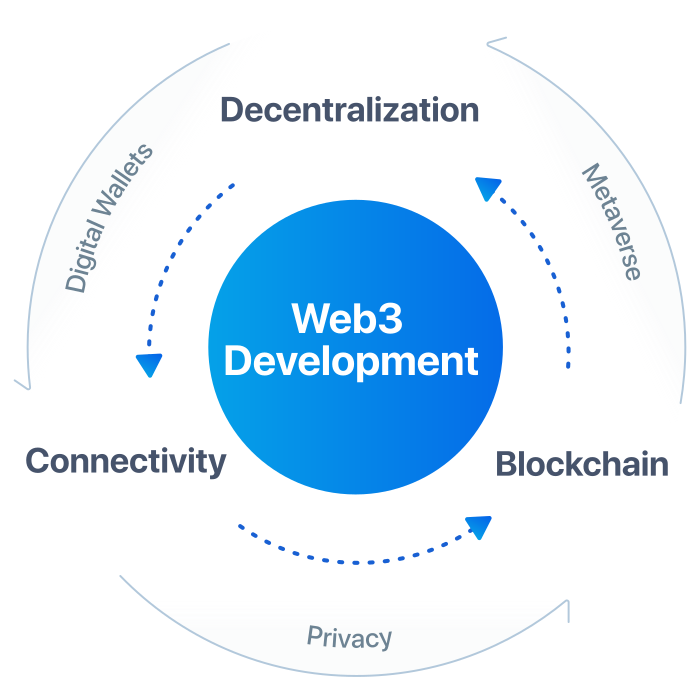
Choose a platform that supports zero-knowledge proofs and meets regional standards like GDPR or MiCA. Providers such as Polygon ID or Block Identity offer infrastructure that allows verification without exposing raw personal data. Ensure the provider’s smart contracts have undergone independent security audits.
Run simulations where users revoke access or where credentials expire. Verify that your system correctly handles these state changes without leaving orphaned data on the blockchain. Test how your identity layer interacts with existing Web2 login systems to ensure a smooth transition for non-crypto native users.
Launch the identity infrastructure in a limited capacity first. Monitor for gas price spikes, failed verification transactions, or user drop-off rates. Establish a clear fallback mechanism, such as traditional email-based verification, for moments when the blockchain network is congested or the smart contract encounters an error.
No comments yet. Be the first to share your thoughts!